inicio mail me! sindicaci;ón

Archive for eresearch

UpSkills Program 2010 Semester: Unimelb.

UpSkills Graduate Research (UpSkills GR) at the Melbourne School of Graduate Research is a series of free workshops and seminars open to all currently enrolled University of Melbourne graduate research students.

eResearch Seminar Series

Program: Semester One 2010

The research environment is experiencing significant change driven by advances in technology. The term ‘e-Research’ encapsulates research activities that use a range of information and communication technology (ICT) and embraces new research methodologies.
This seminar series aims to familiarise graduate researchers with skills, methodologies, tools and issues to enable them to participate effectively in the e-Research environment. Please ensure you have read the UpSkills GR Policy 2010

  • Twitter
  • Facebook
  • Delicious
  • MySpace
  • CiteULike
  • Technorati Favorites
  • LinkedIn
  • Share/Bookmark

What is eResearch in the Arts and Humanities

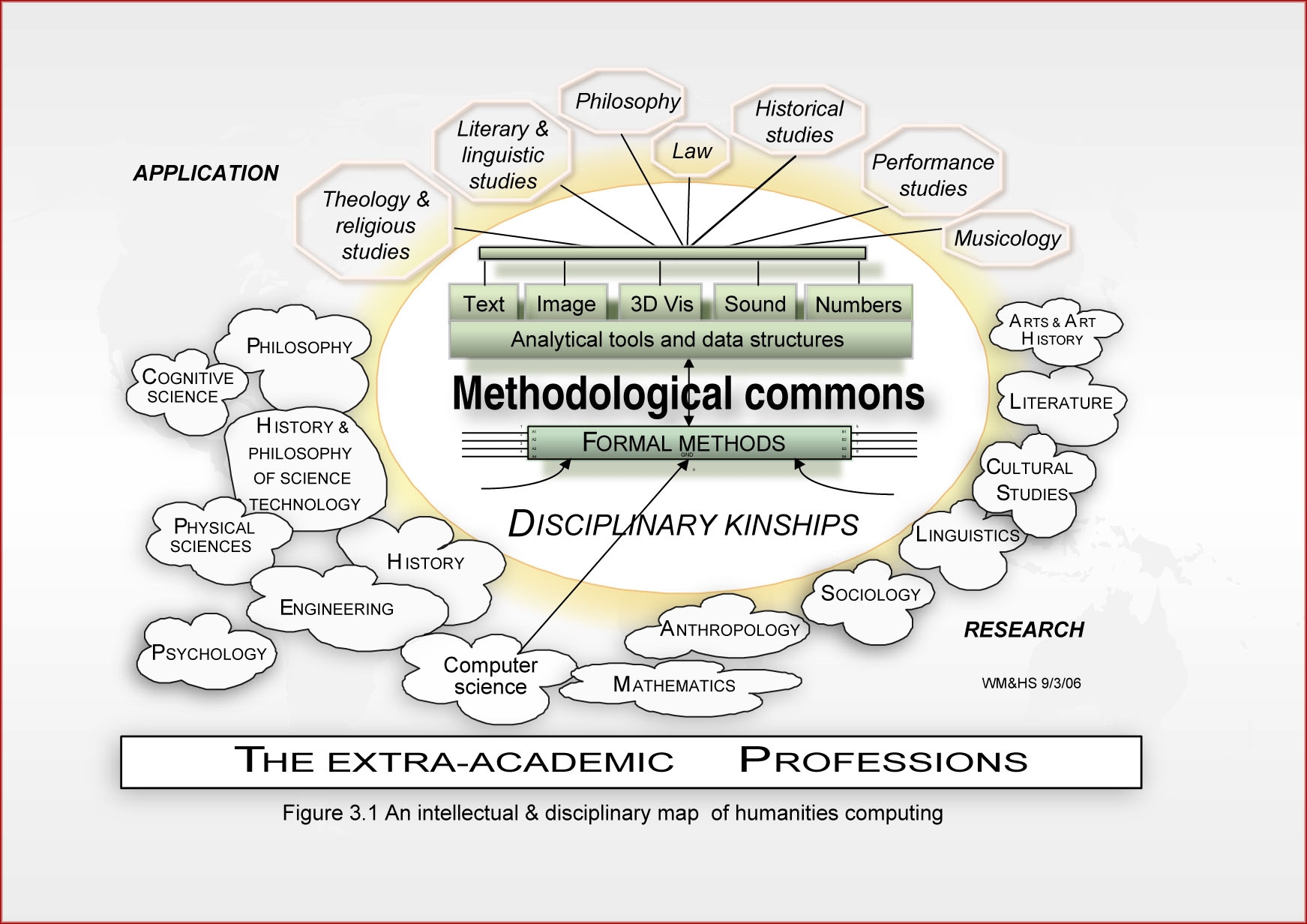
This is the start of a ‘white paper’ on eResearch in the Arts and Humanities. Comments are most welcome (I do admittedly rely a little too much on Susan Hockey’s wonderful history of Digital Humanities in ‘A Companion to Digital Humanities).1

…by its very nature, humanities computing has had to embrace “the two cultures”, to bring the rigour and systematic unambiguous procedural methodologies characteristic of the sciences to address problems within the humanities that had hitherto been most often treated in a serendipitous fashion (Susan Hockey)

What are the Digital Humanities?

The disciplines and sub-fields that make up the humanities have a long interdisciplinary relationship with computing. Since the Italian Jesuit Priest, Father Roberto Busa approached Thomas. J Watson of IBM in 1949 to assist him in indexing some 11 million words of Medieval Latin, numerous humanities scholars have had productive if not at times challenging relationships with computing. Some of the early computing tasks set by humanities scholars included verification of authorship of disputed texts, automating the laborious task of creating concordances on seminal texts, and encoding and defining document structures for digital publication and analyses. Literature and linguistics were the forerunners of computing in the humanities, spreading out to other disciplines at later stages depending on the specific needs and questions of the disciplines and the capabilities of digital technologies.

The term ‘Digital Humanities’ is a banner term that encompasses all the disciplines in the humanities and the meaningful use of computing within them. As a field it is interdisciplinary by nature and although its definition is hotly disputed, it is generally agreed that ‘humanities computing’ or ‘digital humanities’ is an attitude towards computing encompassing theoretical sophistication and an applied technical know-how. It is this balance between the needs of the humanities and the needs of applied computing that is the most taxing aspect of the field. Accordingly the institutional arrangements of the field differ vastly from applied computing centres to full academic departments. The knowledge in the field is communicated through established journals and conferences as well as through a plethora of digital means.

What is eResearch?

The broader eResearch agenda, largely driven by the need to store and re-use the vast amounts of data produced by modern research, provides another set of challenges and opportunities for the humanities. eResearch, commonly referred to ‘Cyberinfrastruture’ in the US or ‘eScience’ in Europe, is largely an infrastructure movement to support ‘big science’. eResearch may be understood as a response to the pressing needs for large scale, interdisciplinary and trans-national collaborations using important data sets and analytical tools to address some of the most pressing questions facing humankind. The planets diminishing energy resources, stressed atmosphere and rising temperatures are problems too large to be dealt with by one discipline, one university or indeed one nation state. Large scale problems require large scale research collaborations and the accompanying infrastructure to support them. Climate data sets, agricultural crop data, emissions measurements, and historical data may be combined, collaborated upon, and communicated in such a way to create new knowledge and thus new approaches.

On a less monumental scale, eResearch enables researchers to address all sort of problems associated with the management of data, the citation of data, the location of data, and the communication of data. Although the humanities do not have the same set of challenges in terms of ‘the data deluge’ as the sciences, the humanities do produce (and need to manage) data in the form of oral interviews, image databases, text resources, and other varied accounts of the human condition. Humanities data is often laborious and expensive to produce, yet highly reusable in subsequent research contexts.

What is Data?

For the humanities, the term ‘data’ is rarely used to describe the apparatus of the research process, except perhaps in terms of those disciplines that engage in gathering data through ‘field work’ in social studies or empirical archival investigations. However, in the digital domain, where seminal corpuses, libraries, literature, and language resources are increasingly in digital form, almost any resources that helps scholars understand the human condition may be understood as ’data’. Records of the Old Bailey, newspapers, parliamentary papers, and court records are not only digital facsimiles of their original published online, but are also to all intents and purposes, ‘data’ that can be holistically analysed, compared and contrasted, and utilised as evidence in a similar way to a scientist understands data. Placing a million books online is a notable exercise in distribution, but the more remarkable attribute of a million books in digital form is that when viewed as data, they may be extracted in such a way to construct meaning that helps us understand new knowledge about these books that is beyond the scope of traditional scholarly labour.

What is architecture?

To take advantage of some of the computing infrastructures being built within the broader eResearch agenda, the ‘computing architecture’ must be built in such as way to take account of researchers working practices. In the humanities, the context of the ‘data’ is important as it is through context that humanities scholars establish the veracity of the resources and its subsequent meaning. Humanities scholars often require sophisticated anthologies to establish how knowledge ‘came into being’ (and its relationships), so that it can be built upon though monographs and articles. It must also have the ability to be cited so that its original location can be verified; of similar importance to the repeatability of the scientific method in science. Well designed Humanities architectures are a mix of more generic ‘services’ common to humanities practices; often containing tools and services more specific to disciplines and research questions.

The challenges and opportunities of eResearch in the Arts and Humanities

Perhaps the greatest benefit of the eResearch within the arts and humanities, beyond the many useful services and resources already produced, is that it allows humanities scholars to engage with advanced computing and imagine what is possible. We may not always get this right; it is an interdisciplinary experiment of methods and approaches, of tool development and application which promise to augment the humanities critical, analytics and speculative skills, or if driven by the wrong impulses, abate them. eResearch in the arts and humanities is a something that the humanities themselves must grasp and lead.

1. Susan Hockey, ‘The History of Humanities Computing” A Companion to Digital Humanities, ed. Susan Schreibman, Ray Siemens, John Unsworth. Oxford: Blackwell, 2004.
http://www.digitalhumanities.org/companion/,

  • Twitter
  • Facebook
  • Delicious
  • MySpace
  • CiteULike
  • Technorati Favorites
  • LinkedIn
  • Share/Bookmark

Paul Walk from the UK’s UKOLN – Engaging developers, supporting innovation

Paul Walk - Engaging developers, supporting innovation from VeRSI on Vimeo.

  • Twitter
  • Facebook
  • Delicious
  • MySpace
  • CiteULike
  • Technorati Favorites
  • LinkedIn
  • Share/Bookmark

Victorian eResearch Review

The State Government of Victoria (Australia) has invested a reasonable sum in eResearch activities here in Victoria over recent years. The Government is undertaking a review; the discussion paper is available online with 36 Key Questions (and some of them are really hard like ‘how can the progress and uptake of eResearch be measured’.

The document is online and responses are due by March 25th (link).

  • Twitter
  • Facebook
  • Delicious
  • MySpace
  • CiteULike
  • Technorati Favorites
  • LinkedIn
  • Share/Bookmark

What is VeRSI?

Overview of VeRSI from VeRSI on Vimeo.

  • Twitter
  • Facebook
  • Delicious
  • MySpace
  • CiteULike
  • Technorati Favorites
  • LinkedIn
  • Share/Bookmark

Leaked climate change emails scientist ‘hid’ data flaws

This is one of the reasons we have eScience and citable, re-usable (and verifible) data.

Phil Jones, the beleaguered British climate scientist at the centre of the leaked emails controversy, is facing fresh claims that he sought to hide problems in key temperature data on which some of his work was based.

A Guardian investigation of thousands of emails and documents apparently hacked from the University of East Anglia’s climatic research unit has found evidence that a series of measurements from Chinese weather stations were seriously flawed and that documents relating to them could not be produced (link to Guardian).

  • Twitter
  • Facebook
  • Delicious
  • MySpace
  • CiteULike
  • Technorati Favorites
  • LinkedIn
  • Share/Bookmark

On being critical…

obama-infrastructure-plans

A recent post I placed on Humanist; one of the most important academic initiatives in the Digital Humanities run by Professor Willard McCarty of the Centre for Computing in the Humanities at King’s College London. In this post, I sort of hijacked the subject somewhat but this needed to be said because as I see it, the otherwise wonderful infrastructure agenda in the Digital Humanities in this instance lacks clarity and purposefulness.

From: Willard McCarty <willard.mccarty@mccarty.org.uk>
Subject: critical thinking

What I think all this has to do with computing is in our understanding
better what computing has to do with the culture in which it has surfaced.
The utilitarian argument (“the computer is useful”) is so trite, so dull, so
incapable of supporting for long the professional activity we would like to
see given a better place in the sun. The principle of reprocity that governs
human relations says we need to be useful for sure, but to attract the sort
of students we want as well as keep ourselves alive intellectually I’d think
we need to offer something with a real bite to it. What has that bite? Not a
totally paranoid vision, though the thrill of the threat of it is a start.

Dear Willard and Humanist,

This is an interesting argument and given the institutional arrangements of the Digital Humanities, they aren’t going to be resolved quickly. I think where we find ourselves in the Digital Humanities is wedged somewhere between a contemporary version of CP Snow’s Two Cultures argument. But rather than wedged between ‘Science’ and ‘Humanities’ we find ourselves stuck somewhere between highly skilled technical  labour and academic labour. They are both two very valuable and different cultures with divergent approaches to work, merit, aspiration, and research significance. This division is especially problematic in the UK context given the history of the class system where working class kids went to technical school and middle class kids were given the opportunity to become academics. This of course changed significantly with mass tertiary education and the rise of the Polytechnics.

Read the rest of this entry »

  • Twitter
  • Facebook
  • Delicious
  • MySpace
  • CiteULike
  • Technorati Favorites
  • LinkedIn
  • Share/Bookmark

Open Science and Data

As part of JISC’s ‘Research 3.0 – driving the knowledge economy’ activity
which launches at the end of November, a new Open Science report released
today trails key research trends that could have far-reaching implications for
science, universities and UK society.

The report written by UKOLN at the University of Bath and the Digital Curation
Centre, identifies open-ness, predictive science based on massive data
volumes and citizen involvement as being important features of tomorrow’s
research practice.

It is hoped that this document will stimulate and contribute to community
discussion in the UK, which is ranked second in the world for its output of
quality research, but also fuel the open science debate on the global stage.
Read the rest of this entry »

  • Twitter
  • Facebook
  • Delicious
  • MySpace
  • CiteULike
  • Technorati Favorites
  • LinkedIn
  • Share/Bookmark

What to do with 30 million books?

376152628_249e3630c0

(Posted to that wonderful Digital Humanities list, Humanist).

Date: Wed, 14 Oct 2009 18:22:57 +0100
From: Jockers Matthew <mjockers@stanford.edu>
Subject: Possible Text Mining Opportunity at Stanford

Friends,

As I’m sure many of you already know, Stanford has been closely
involved with Google’s book scanning project, and we (Stanford) are
currently preparing a proposal for the creation of a text mining /
analysis Center on campus. The core assets of the proposed Center
would include all of the Google data (approx. 30 million books) plus
all of our Highwire data and all of our licensed content. We see a
wide range of research opportunities for this collection, and we are
envisioning a Center that would offer various levels of interaction
with scholars. In particular we envision a “tiered” service model
that would, on one hand, allow technically challenged researchers to
work with Center staff in formulating research questions and, on the
other, an opportunity for more technically advanced scholars to write
their own algorithms and run them on the corpus. We are imagining the
Center as both a resource and as a physical place, a place that will
offer support to both internal and external scholars and graduate
students. We are looking at creating fellowship opportunities and
post docs as well as other ways of encouraging and supporting
scholarship.

I am writing to you specifically because I think this will be
something you are interested in but also because at this stage of the
proposal we are looking for some external validation that this corpus
would be of value and that the research it would support would inspire
new questions and new knowledge. I have already polled our Stanford
faculty, and the response (especially in the humanities and social
sciences) has been very enthusiastic. My hope is that you might be
able to send a few words (at most a short paragraph) that I could add
to a section of our proposal that is titled “Scholarly Interest and
Research Potential”.

Hope you are all well and getting your abstracts polished for London
in 2010.

Matt


Matthew Jockers
Stanford University
http://www.stanford.edu/~mjockers

  • Twitter
  • Facebook
  • Delicious
  • MySpace
  • CiteULike
  • Technorati Favorites
  • LinkedIn
  • Share/Bookmark

Report back: IRCHSS Symposium: Digital Humanities – New Frontiers, Trinity College, Dublin, 14 October 2009

A one day seminar was held at Trinity College Dublin on Wednesday 14 October to discuss Ireland’s contributions to the Digital Humanities and the possible futures of the field within Ireland. http://dho.ie/node/634 The seminar, held in a skilfully restored 19th Century Anatomy lecture theatre, was attended by representatives from government, the Irish Research Council (IRCHSS), universities, and industry (Microsoft, IBM, Intel). The keynote speaker was Professor Tony Hey, Corporate Vice President of Microsoft’s External Research and former head of the UK’s eScience Core Programme. Other attendees included the Irish Minister of Education, the Provost of Trinity College, the Director of the Digital Humanities Observatory Ireland, and representatives from IBM and Intel’s research divisions.

Professor Hey discussed ‘eScience’ and how it may be a new way to do science. He discussed the shift from experimental science to data intensive science. He explained that building datasets, using datasets, and analysing datasets had become a ‘new paradigm’ within scientific research. However, this shift is not exclusive to scientific research and ‘eScience’ offers new opportunities to the humanities as well. But there is a need to put data into a form and create the tools that are useful for the humanities (putting data into a useful form is partly the work of the Centre for Computing in the Humanities at King’s and the Digital Humanities Observatory). He showed some of the work of Microsoft including a video presentation, transcription and annotation system called Project Tuva. This project features the work of Dr Richard Feynman, a famous scientist at Cornell, and allows users to search and annotate videos of his lectures. http://research.microsoft.com/apps/tools/tuva/ .

Although not really Digital Humanities, he did show some of the other work of Microsoft’s 800 plus research scientists scattered around the world. Some of this work admittedly made me a bit nervous, especially Microsoft’s data centres that are each about the size of Dublin. The data centres represent a shift in Internet thinking from the autonomous computing and storage capacities of desktops (and various institutional computing facilities), to large centralised warehouses controlled by corporations such as Microsoft. Professor Hey touted the benefits of data centres for ‘cloud computing’ (ie. use of tools and services at a remote location), but in my mind, these centres give a lot of control to Microsoft and we must take it on good faith that Microsoft will always have our best interests in mind.

Martin Curley, Director of IT innovation at Intel Information Technology (based in Ireland), responded to Hey’s talk, but unfortunately at times, deferred to the flabby arguments of technological determinism with the usual utopian visions of ‘more computers make things better’ (why do utopian visions never imagine free Guinness?). He did make some interesting points about the ‘grand challenges’ facing the world and how these are, in part, being addressed through European Commissions Framework 7 Programme (focussed upon building the research infrastructure capacities in Europe). Humanists must always work alongside scientists in addressing ‘grand challenges’ as we already know that the ice caps are melting and that the world is running out of oil, but we also desperately need to understand the potentially catastrophic societal dimensions of this (and surly part of the cause is rampant consumerism driven by corporate globalism, but I would never infer such a thing in such company).

Other presentations during the day included more content-specific presentations such as the magnificent 1641 Depositions Project, presented by Dr Marie Wallace, that contains 20, 000 pages of witness testimonials about the massacre of Protestants in Ireland in 1641. Dr Seth Denbo discussed the DARAIH project (Digital Research Infrastructure for the Arts and Humanities) and its aim to link researchers to important data sets held in major data centres throughout Europe. The project has 14 partners in 10 countries and plans to build a ‘discovery architecture’ so that researchers can find important data resources and incorporate them into their working practices and solve ‘real world’ research problems.

Dr Susan Schreibman, the Director of the Digital Humanities Observatory (DHO), discussed the work of her centre and emphasised the importance of building the human infrastructure as well as the technical infrastructure to support the research community. She explained that the Digital Humanities is not only about technical capacities, it is also about people and practices. I would like to think this is always the case, but often the short-term practical solution, devoid of the critical, contextual, and reflective apparatus of the humanists, triumphs. If we don’t understand the humanistic context of the technologies that we use (ie. how they help us understand human society), then we don’t always know how to apply the right technical solution to the right humanist problem. Computing, if poorly considered, can also damage scholarship and our relationship with the human record.

The seminar ended with a reception at the Provost’s house, Professor Andy Orchard, on the grounds of Trinity College.

Projects/papers/resources presented at the seminar include:

DSCF1060

Dr Susan Schreibman with the Provost of Trinity College, Andy Orchard.

DSCF1034

Anatomy lecture theatre, Trinity College, Dublin

  • Twitter
  • Facebook
  • Delicious
  • MySpace
  • CiteULike
  • Technorati Favorites
  • LinkedIn
  • Share/Bookmark

Report back: ‘Tools for Scholarly Editing over the Web’ Birmingham, 24 September

I attended the ‘Tools for Scholarly Editing over the Web’ workshop on Thursday (24 September) organised by the Institute for Textual Scholarship and Electronic Editing at the University of Birmingham. There were presentation by many leading figures of electronic textual editing from the US, Canada, Germany, Italy, Australia, Ireland, and Britain. The workshop was organised to discuss the movement towards online collaborative tools for scholarly editing and the problems and opportunities associated with this. Peter Robinson the Director of the Institute of Textual Scholarship and Electronic Editing and organiser of the event outlined the major issues as 1) ownership and control, 2) sustainability, and 3) interoperability (these were discussed in detail at a separate session on the second day) .

Joris van Zundert from the Huygens Institute in The Hague spoke first about moving humanities tools towards ‘networked services’. Many tools are developed for individual projects and are not often re-usable within other projects. By providing  tools online (or ‘micro services’ that can be plugged into a generic software frameworks), other projects may use them to say, parse TEI XML texts, tokenise texts, or apply other methods required to transcribe and annotate text. His vision,  shared by many projects, is for scholars to obtain their text from digital repositories, pipe it through a number of micro-services, and then end up with annotated and transcribed data. The particular content that Zandert is working with is critical editions of Middle Dutch; not easily automated through Optical Character Recognition Systems (thus a collaborative translation system is required).

Read the rest of this entry »

  • Twitter
  • Facebook
  • Delicious
  • MySpace
  • CiteULike
  • Technorati Favorites
  • LinkedIn
  • Share/Bookmark

eResearch Australasia Newsletter

The eResearch field in Australasia produces a monthly newsletter to inform punters of developments in the field. It is published online and via email.

A monthly newsletter carrying items of interest to the Australasian eResearch community is published via the mailing list eresearch-announce@eresearch.edu.au and archived here.  If you would like to subscribe, send a plain text message to majordomo@eresearch.edu.au with the words subscribe eresearch-announce in the message body. You can unsubscribe at any time.

If you have an item you would like to include in the newsletter, please send it to newsletter@eresearch.edu.au.  The newsletter is published the first business day of each month, and submissions are due two business days prior to that.  Each item should be no more than 150 words of plain text with a link for further information (link to newsletter)

  • Twitter
  • Facebook
  • Delicious
  • MySpace
  • CiteULike
  • Technorati Favorites
  • LinkedIn
  • Share/Bookmark

Scientific Collaborations on the Internet

collab

(A fantastic book for e-Science buffs!)

Modern science is increasingly collaborative, as signaled by rising numbers of coauthored papers, papers with international coauthors, and multi-investigator grants. Historically, scientific collaborations were carried out by scientists in the same physical location—the Manhattan Project of the 1940s, for example, involved thousands of scientists gathered on a remote plateau in Los Alamos, New Mexico. Today, information and communication technologies allow cooperation among scientists from far-flung institutions and different disciplines. Scientific Collaboration on the Internet provides both broad and in-depth views of how new technology is enabling novel kinds of science and engineering collaboration. The book offers commentary from notable experts in the field along with case studies of large-scale collaborative projects, past and ongoing (link)

  • Twitter
  • Facebook
  • Delicious
  • MySpace
  • CiteULike
  • Technorati Favorites
  • LinkedIn
  • Share/Bookmark

JISC Projects start-up meeting: Information environment 2009-11 and Virtual Research Environment, Leicester, 8 July 2009.

The JISC Virtual Research Environment (VRE) III kick-off meeting was held at the University of Leicester 8-9 July 2009. Representatives from JISC attended as well as representatives from the projects that had won funding in the last JISC VRE III and Information Environments funding round. http://www.jisc.ac.uk/whatwedo/programmes/inf11/inf11startup.aspx

The highlight of the meeting was certainly the project presentation segment. New project presentations can be a pretty tedious affair, especially when there are 60 new projects, so even if each project had been given 5 minute to strut-their-stuff, it would have taken 5 hours! So rather than torture the audience for 5 hours, the JISC in its wisdom, allowed each project team a mere 30 seconds!
Read the rest of this entry »

  • Twitter
  • Facebook
  • Delicious
  • MySpace
  • CiteULike
  • Technorati Favorites
  • LinkedIn
  • Share/Bookmark

Christine Borgman lecture@OII

christine_borgman

Christine Borgman gave an interesting lecture at OII (Oxford Internet Institute)  recently (she is one of the Keynote speakers at this years Digital Humanities Conference.  One of the major points that I retained from this talk is that Data is not objective fact. Data is simply the ‘alleged evidence’ as one researchers observations may differ from anthers (this is almost always the case in the humanities). The lecture is available online.

Capturing and curating data for reuse is a key challenge of cyberinfrastructure: Christine Borgman compares developments in scholarly information infrastructure and cyberlearning, reflecting on the implications for scholarship in the digital age (link).

  • Twitter
  • Facebook
  • Delicious
  • MySpace
  • CiteULike
  • Technorati Favorites
  • LinkedIn
  • Share/Bookmark

Next entries »