
inicio mail me! sindicaci;ón

Archive for video

Shoreditch and Brick Lane under threat


The Portable Film Festival

A tiny word from the people at Portable.
www.portablefilmfestival.com

Speak to anyone who has attended a free bar event recently and
you’ll find out it is possible to have too much of a good thing.
Especially when that good thing is champagne. But here at Portable
we deal in content not alcohol, and we’re chucking the stuff
around like there’s no tomorrow.

There are over 450 free downloads featuring some of the year’s
best short films, music videos from Willy Mason and The Shins,
and online serials including Lonely Girl 15 and Galacticast.

Log yourself in at www.portablefilmfestival.com and get glugging


Video Google: A Text Retrieval Approach to Object Matching in Videos

We will demonstrate an approach to object and scene retrieval which searches for and localizes all the occurrences of a user outlined object in a video. The object is represented by a set of viewpoint invariant region descriptors so that recognition can proceed successfully despite changes in viewpoint, illumination and partial occlusion. The temporal continuity of the video within a shot is used to track the regions in order to reject unstable regions and reduce the effects of noise in the descriptors. The analogy with text retrieval is in the implementation where matches on descriptors are pre-computed (using vector quantization), and inverted file systems and document rankings are used. The result is that retrieval is immediate, returning a ranked list of key frames/shots in the manner of Google (link)


BBC and YouTube

The British Broadcasting Corp. began showing excerpts from its news and entertainment programs on the YouTube video-sharing website on Friday, becoming the first international broadcaster to ink a major deal with the Google-owned portal (from the Age, link)


What is Annodex (hypertextual video)?

This fantastic film annotation (ie. hypertextual video) project is being developed by the CSRIO in Australia and other institutions.

When http, html and URIs were invented, the World Wide Web took its shape. With the technology provided here, we extend the Web to audio-visual data: Annodex, cmml and temporal URIs allow the creation of Webs of Videos. They also enable Web search engines to crawl and index audio-visual content. Just apply anything you know from the Web to audio-visual content - that’s Annodex (link).


Vidipedia

A wiki for video…check out this research at the the University of Newcastle (UK) in the field of ‘media computing’ within computer science (thanks to Tobias for the Link)

Releasing the hidden value contained in the tens of millions of hours of the world’s media archives is dependent on the widespread of these collections in order to facilitate access. However, archive owners are reluctant to commit to the costs of digitization until two key enablers occur: (a) A cost effective mechanism to annotate the collection such that potential users can search audio/video content to identify items that will satisfy their information need; and (b) A working business model that supports the costs of digitization by demonstrating new revenue streams as a result of making the collection available. The Vidipedia project seeks to address these needs by examining the potential for community based annotation and identifying a business model that supports it. The project will create a tool that will address the challenges of archiving, search and discovery for producers and consumers of multimedia content. Vidipedia will also enable interoperability at the semantic level between services and systems that support inter-enterprise.


What is icommunity.tv

Thanks to Chris Haller, Director of eParticipation for sending the link.

The concept behind iCommunity.TV originated in a twofold observation: Despite an almost ubiquitous availability of online mapping applications and websites with geo-enabled functionality, no video-sharing website offers the ability to geographically locate content. Secondly, video-sharing is still mostly focused on entertainment and the few video blogs that exist, mainly serve interest groups independent of location.

We believe that people choose the cities and towns they live in not only based on physical but also emotional reasons — the unique heart and soul characteristics of places. Local events, like school events, last week’s hail storm, or an interview with the mayor about the efforts to revitalize downtown, are important events that generate local identity for citizens, but, particularly for small communities or neighborhoods, there are few venues through which these news items are delivered. This means that local news, especially carried over visual channels, has great potential to support and encourage vibrant communities.

Our effort is focused on developing an aggregation platform that ties into video-sharing platforms like Youtube.com, extends their services by letting anyone georeference and sort video clips in news categories, and offers multiple convenient ways to subscribe to and watch these custom channels (e.g. “Politics in Berlin, Germany”).


Viddler goes live

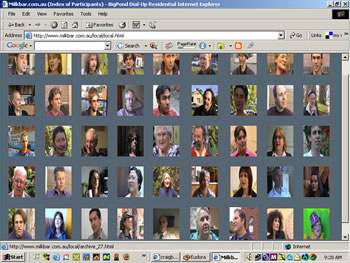
Viddler is one of my favorite new online video distribution systems; simply because you can tag within the video ( a major leap forward I for a main-stream system). This is the sort of thing I was trying to do all those years ago with Milkbar.com.au. It is a form of ‘hypertextual video’ (or what we take for granted in the online text world).


Victoria gets first Greens in Parliament

Greg Barber is one of three Green representatives recently elected to ‘Northern Metropolitan’ region in the 40-seat Legislative Council with Greens colleague Sue Pennicuik and one DLP member (with which he will share the balance of power). These are the first Greens in the Victorian Parliament.

Here is an interview I did with Greg for the project Milkbar.com.au (2001) about the gentrification of Fitzroy.


What is Iqueer?

Thanks to Rodney Croome’s Blog for the Link

iqueer has started as a group of television and multimedia producers keen to exploit developments in high-speed internet access and digital production technology to distribute quality content to a smaller, more specialised gay audience than commercial television could ever hope (or dare) to support.Our aim is to create a channel that screens locally-produced shows across a variety of genres and formats that will appeal to a gay Australian audience…(link)


Morning Coffee with Craig: Do you have time to think?


Information, Communication, and Society Webcasts

In collaboration with the Oxford Internet Institute, the editors of the academic peer-reviewed journal Information, Communication, and Society have been producing and archiving webcasts featuring the author(s) of the lead article of selected issues. (check them out…link)


Elect Borat ?


My Bush Would Make a Better President

This clip was produced by John Power here in Melbourne for Digital Primative. Thanks to AG for the link (link).


Morning Coffee with Craig: What is political bias?

The term ‘bias’ has been used a lot lately in Australia by the Conservative administration, but do they actually know what it means? Today I ponder the idea of ‘bias’ from the most objective position available to me; my own perspective. In fact I am the most un-bias person in the whole world and if you don’t agree with me then you must be ‘bias’.


Next entries »